Behind the paper · HICSS · 2027 · forthcoming
Beyond documentation: Indigenous-informed design knowledge for language revitalization
Digital archives preserve languages. Keeping them alive is a different design problem, and Indigenous knowledge has to shape it.
“Early in 2026 I spent three weeks in Guatemala, living with a Maya family in a Tz’utujil-speaking environment.”
Read the story behind the paper
In brief
Documenting a language does not revive it.
Four in ten languages are at risk. Digital systems have mostly archived them, while revitalization is a broader, political design problem.
Eleven initiatives, read as design knowledge.
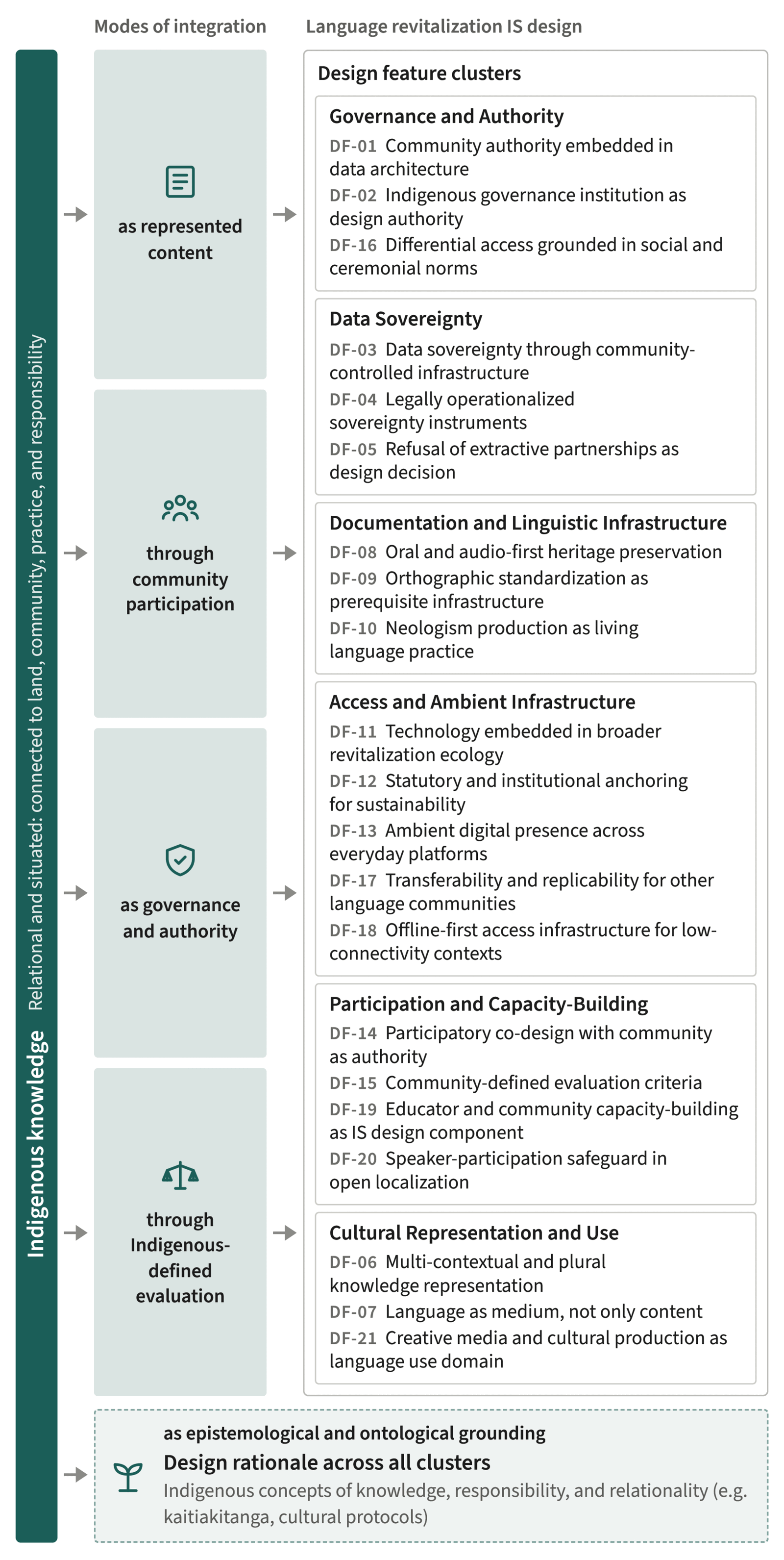
Fifty-five situated features reconstructed and abstracted into twenty-one cross-case design features in six clusters.
Five ways Indigenous knowledge enters a design.
From represented content and participation to governance, Indigenous-defined evaluation, and epistemological grounding.
Provisional, and deliberately so.
The vocabulary is an opening whose validity must be earned through community-led inquiry.
01 / The starting point
“I do not speak my language.”
The paper opens with an encounter in Guatemala. Near Tikal, a local guide described his situation in a sentence that condenses the whole problem: Spanish is not his language, English is not his language, and he does not speak his own. He was referring to Itza, a Maya language with fewer than fifty fluent speakers left (University of Toronto, 2025). A language can remain part of who you are even after its transmission from one generation to the next has already broken.
The encounter is treated as what it is: a personal, sensitizing moment, not evidence about Maya communities and not a license to speak for them. What it motivates is a design question. Digital systems have become part of language work everywhere. Can they do more than store what is left?
02 / The distinction
Documenting a language does not revive it.
The literature separates three things. Documentation records a language: dictionaries, grammars, recordings, stories (Austin & Sallabank, 2018; Grenoble & Whaley, 2005). Preservation safeguards those resources for later. Revitalization is broader. It restores and expands the use of a language across social domains and generations, and its central benchmark is whether children acquire and actually use it (Fishman, 1991; Grenoble & Whaley, 2005).
Digital archives, corpora, and online dictionaries are documentation infrastructure (Galla, 2016; Garrett, 2018). They matter, and with the last fluent speakers aging, recording is time-critical. But none of it revives a language on its own. Revitalization-oriented systems have to support language as lived practice inside a larger ecology of speakers, learners, families, schools, media, institutions, and governance (Fishman, 1991; Hinton et al., 2018).
That makes it an information systems problem. A system embeds assumptions about access, openness, classification, authorship, ownership, and authority. If those assumptions come from dominant Western defaults, the system may reproduce exactly the marginalization that endangered the language, reducing it to decontextualized words and phrases (Meighan, 2021). The design-relevant question is therefore not what should be digitized, but who defines the problem, who controls representation and access, and whose criteria determine whether the system is valuable (Chung et al., 2024; Smith, 2021).
03 / The approach
Reading initiatives as design knowledge.
No community was studied directly. Instead, the paper reads eleven documented initiatives as sources of design knowledge. They were identified from the literature on digital language revitalization (Galla, 2016; Hinton et al., 2018; Llanes-Ortiz, 2023) and from project documentation, and selected to vary in the role the system plays and in how far Indigenous knowledge shapes it. Welsh is included deliberately as a boundary case: a minoritized but not Indigenous language where state institutions rather than Indigenous knowledge dominate (Williams, 2014).
| Initiative | Language context | Primary role of the system |
|---|---|---|
| Mukurtu CMS | Warumungu; 600+ communities | Governance infrastructure |
| FirstVoices | 85+ First Nations, British Columbia | Community archive & learning |
| Te Hiku Media / Papa Reo | Māori | AI and NLP infrastructure |
| Hawaiian language technology | ʻŌlelo Hawaiʻi | Use-enabling infrastructure |
| Cymraeg 2050 | Welsh, as a boundary case | Ambient language infrastructure |
| ALMG digital tools | 22 Guatemalan Maya languages | Documentation & normative authority |
| Maya Language Wiki | Yucatec Maya, Kaqchikel, 20 Mayan languages | Documentation repository |
| RACHEL Digital Libraries | Tz’utujil, Kaqchikel, K’iche’ | Offline access infrastructure |
| Firefox localization | Kaqchikel Maya | Software localization |
| ADN Maya | Yucatec Maya | Creative media platform |
| Conetamalli | Popti’, Q’eqchi’, K’iche’, Poqomchi’ | Community translation tool |
The analysis ran in four steps between April and June 2026. From 38 documents, 55 situated features were extracted: concrete functions, governance arrangements, access structures, participation mechanisms, and reported uses. Each initiative was then profiled. Features were compared across cases and abstracted into 21 cross-case design features, which were finally grouped into six clusters. The move from situated feature to cross-case design feature follows the logic of design science research (Hevner et al., 2004; Strohmann et al., 2026), and the paper is candid that this very move carries the risk of decontextualization it warns against.
04 / Findings
Twenty-one design features in six clusters.
The design vocabulary is the paper’s main result. A few features illustrate what it captures. In Mukurtu, access is governed by community-defined cultural protocols that are more granular than the usual public, registered, and administrator roles (Christen, 2015): authority is a structural property of the system, not a moderation policy layered on top. Te Hiku Media keeps Māori language data and the speech technologies derived from it under community control, attaches a Kaitiakitanga license that travels with the data, and refuses extractive partnerships as a design decision, a stance that matches the call for relational rather than extractive language technology (Bird, 2024). RACHEL libraries in Guatemala work offline because connectivity cannot be assumed. And several cases show that revitalization needs new words for new domains, because a language that cannot name a browser tab cannot be lived in.
Governance and authority
- Community authority embedded in data architecture
- Indigenous governance institution as design authority
- Differential access grounded in social and ceremonial norms
Data sovereignty
- Data sovereignty through community-controlled infrastructure
- Legally operationalized sovereignty instruments
- Refusal of extractive partnerships as design decision
Documentation and linguistic infrastructure
- Oral and audio-first heritage preservation
- Orthographic standardization as prerequisite infrastructure
- Neologism production as living language practice
Access and ambient infrastructure
- Technology embedded in broader revitalization ecology
- Statutory and institutional anchoring for sustainability
- Ambient digital presence across everyday platforms
- Transferability and replicability for other language communities
- Offline-first access infrastructure for low-connectivity contexts
Participation and capacity-building
- Participatory co-design with community as authority
- Community-defined evaluation criteria
- Educator and community capacity-building as IS design component
- Speaker-participation safeguard in open localization
Cultural representation and use
- Multi-contextual and plural knowledge representation
- Language as medium, not only content
- Creative media and cultural production as language use domain
05 / Modes
Five ways Indigenous knowledge enters a design.
A system related to an Indigenous language is not automatically Indigenous-informed. Across the cases, Indigenous knowledge becomes consequential for design in five distinct modes, and initiatives combine them differently. The modes build on the argument that Indigenous knowledge can itself serve as justificatory knowledge for design (Chung et al., 2024). Many foreground content, access, and visibility. Mukurtu and Te Hiku Media show the deeper end, where cultural protocols shape the access architecture and a concept such as kaitiakitanga, a Māori principle of guardianship, informs licensing and infrastructure choices.
- 1
Represented content
The system holds Indigenous-language or cultural material.
- 2
Community participation
Speakers, educators, translators, Elders, or organizations contribute to content, localization, validation, or use.
- 3
Governance and authority
A community or Indigenous institution holds decision rights over access, classification, ownership, or reuse.
- 4
Indigenous-defined evaluation
Success is stated in the community’s own terms, not in user counts or content volume.
- 5
Epistemological and ontological grounding
The design rationale invokes an Indigenous concept of knowledge, responsibility, land, or relationality.
06 / Tensions and limits
Projectable and context-sensitive.
Three tensions run through the findings and will confront any future project. Openness against protection: wide access supports learning and visibility, but unrestricted openness can violate cultural protocols and data sovereignty, which is the tension the CARE Principles for Indigenous Data Governance were formulated to address (Carroll et al., 2020). Standardization against plurality: digital systems want stable orthographies and metadata, while languages carry regional variation, oral traditions, and contested authority. Scalability against situatedness: reusable platforms can serve many communities only if they stay adaptable to local histories and governance.
The study relies on public documentation, which shows what systems intend and offer but little about actual use or community-defined outcomes. And I write as a Western European researcher who does not represent the communities involved, which also means that the categories I use to reconstruct design knowledge are not culturally neutral (Chughtai & Young, 2025; Smith, 2021). The 21 design features are offered as contestable openings, not conclusions. What comes next has to be participatory and community-led, with communities defining the problem, the categories, and what counts as success (Hermes et al., 2012; Meighan, 2021; Smith, 2021).
Behind the paper
The idea, and
the path to it.
A paper presents the polished result. This is the part that usually stays unwritten: where the question came from and how the work actually unfolded.
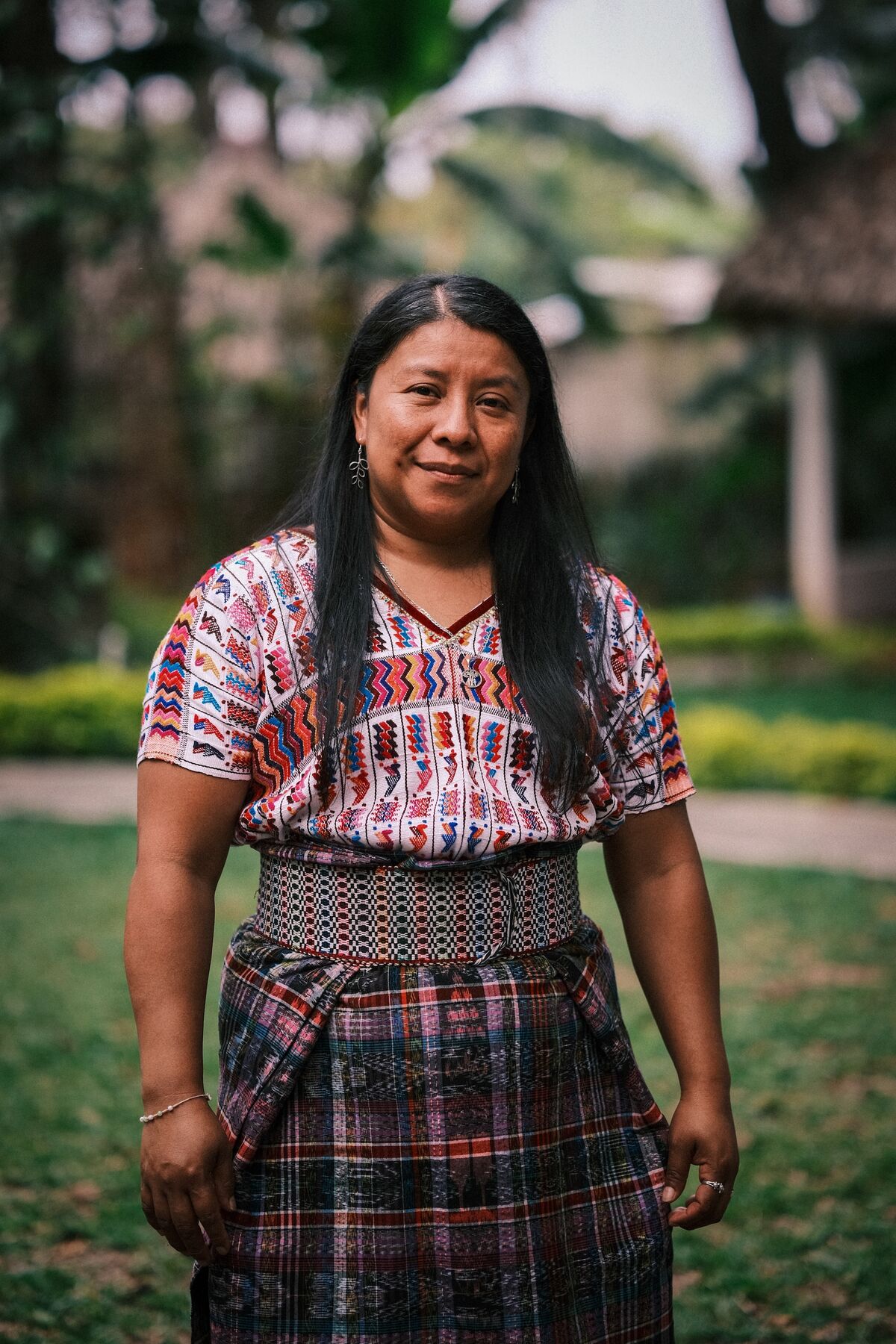
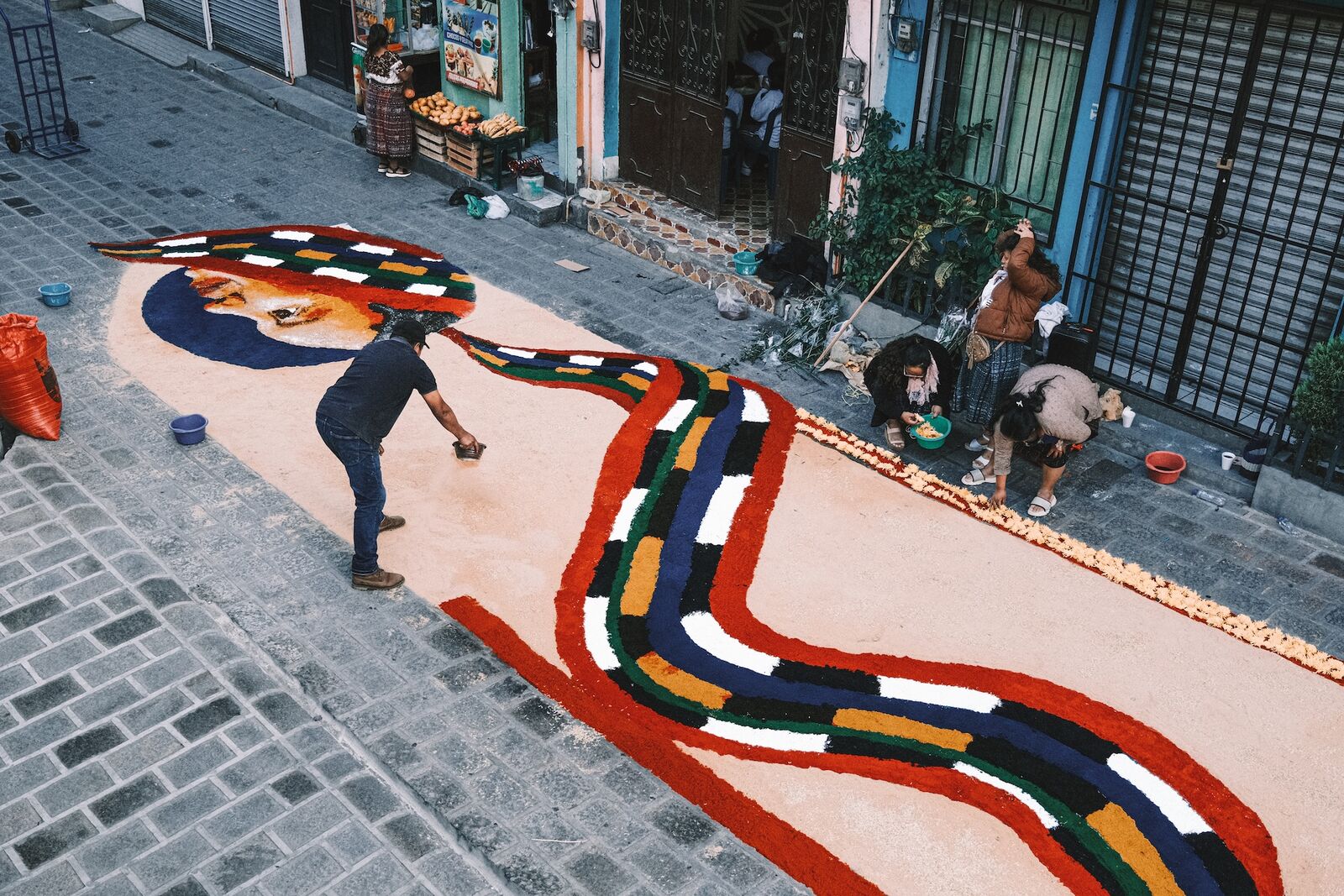
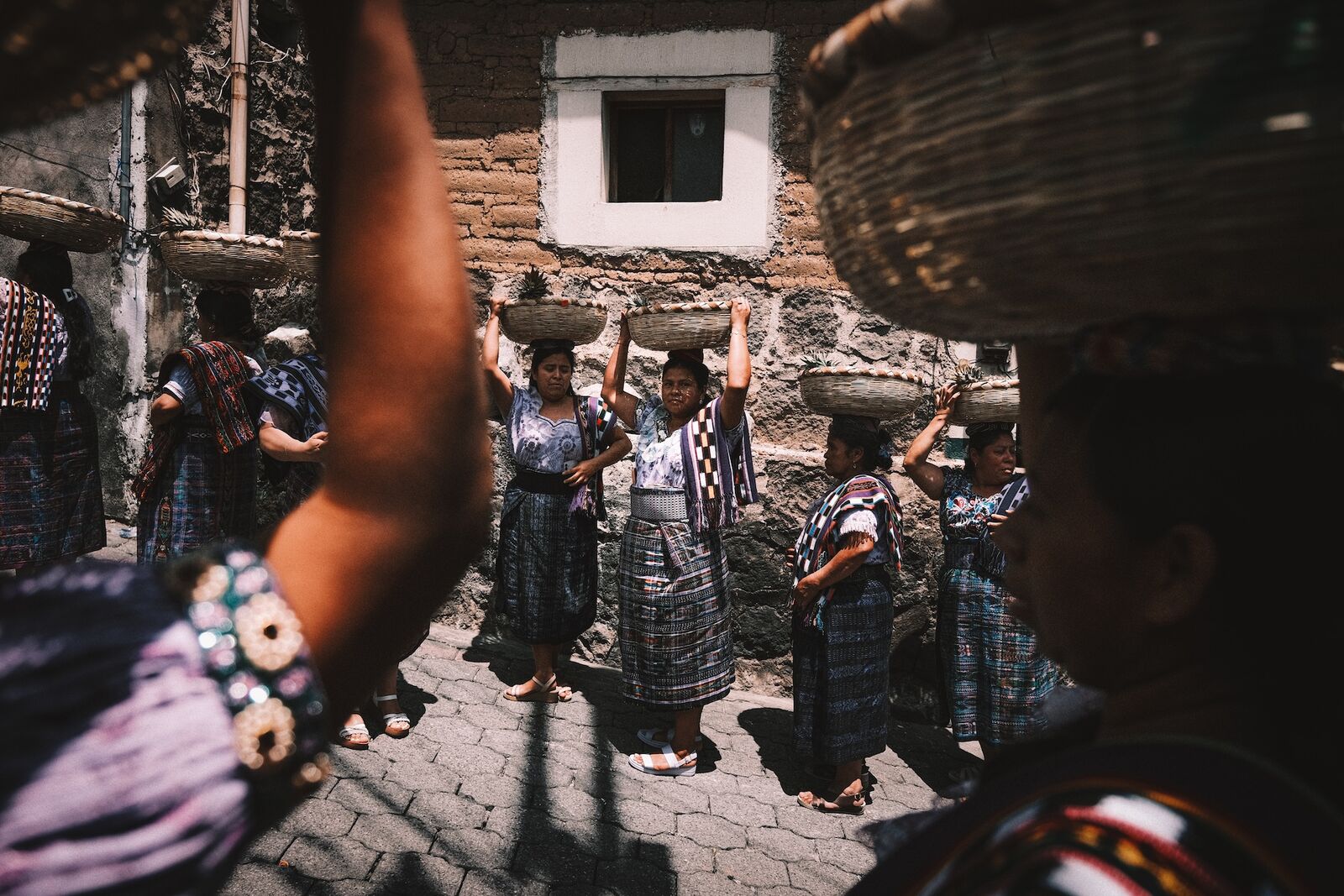
The reflexive position is written into the paper itself. Early in 2026 I spent three weeks in Guatemala, living with a Maya family in a Tz’utujil-speaking environment. That confronted me with Indigenous languages in a way reading never had, and it made me realize how endangered so many of them are.
Afterwards I read and researched, and after those encounters I could not stop. Much of what I learned along the way frightened me about the state of the world’s languages. That is what motivated me to contribute and to move in this direction. This paper is my first step into Indigenous research: an attempt to get an overview of what the current landscape of systems looks like, and of how Indigenous knowledge can enter design processes.

References
Austin, P. K., & Sallabank, J. (2018). Language documentation and language revitalization: Some methodological considerations. In L. Hinton, L. Huss, & G. Roche (Eds.), The Routledge handbook of language revitalization (pp. 207–215). Routledge.
Bird, S. (2024). Must NLP be extractive? In Proceedings of the 62nd Annual Meeting of the Association for Computational Linguistics (Volume 1: Long Papers) (pp. 14915–14929). Association for Computational Linguistics. doi:10.18653/v1/2024.acl-long.797
Carroll, S. R., Garba, I., Figueroa-Rodríguez, O. L., Holbrook, J., Lovett, R., Materechera, S., Parsons, M., Raseroka, K., Rodriguez-Lonebear, D., Rowe, R., Sara, R., Walker, J. D., Anderson, J., & Hudson, M. (2020). The CARE Principles for Indigenous Data Governance. Data Science Journal, 19(1), Article 43. doi:10.5334/dsj-2020-043
Christen, K. (2015). Tribal archives, traditional knowledge, and local contexts: Why the “s” matters. Journal of Western Archives, 6(1), Article 3. doi:10.26077/78d5-47cf
Chughtai, H., & Young, A. G. (2025). Decoloniality and information systems: Making local contexts relevant to IS research. Information Systems Journal, 35(4), 1285–1293. doi:10.1111/isj.12579
Chung, A., Shedlock, K., & Corbett, J. (2024). Decolonizing information technology design: A framework for integrating Indigenous knowledge in design science research. Proceedings of the 57th Hawaii International Conference on System Sciences (HICSS-57). aisel.aisnet.org
Fishman, J. A. (1991). Reversing language shift: Theoretical and empirical foundations of assistance to threatened languages. Multilingual Matters.
Galla, C. K. (2016). Indigenous language revitalization, promotion, and education: Function of digital technology. Computer Assisted Language Learning, 29(7), 1137–1151. doi:10.1080/09588221.2016.1166137
Garrett, A. (2018). Online dictionaries for language revitalization. In L. Hinton, L. Huss, & G. Roche (Eds.), The Routledge handbook of language revitalization (pp. 197–206). Routledge.
Grenoble, L. A., & Whaley, L. J. (2005). Saving languages: An introduction to language revitalization. Cambridge University Press.
Hermes, M., Bang, M., & Marin, A. (2012). Designing Indigenous language revitalization. Harvard Educational Review, 82(3), 381–402. doi:10.17763/haer.82.3.q8117w861241871j
Hevner, A. R., March, S. T., Park, J., & Ram, S. (2004). Design science in information systems research. MIS Quarterly, 28(1), 75–105. doi:10.2307/25148625
Hinton, L., Huss, L., & Roche, G. (Eds.). (2018). The Routledge handbook of language revitalization. Routledge.
Llanes-Ortiz, G. (2023). Digital initiatives for Indigenous languages. UNESCO. unesdoc.unesco.org
Meighan, P. J. (2021). Decolonizing the digital landscape: The role of technology in Indigenous language revitalization. AlterNative: An International Journal of Indigenous Peoples, 17(3), 397–405. doi:10.1177/11771801211037672
Smith, L. T. (2021). Decolonizing methodologies: Research and Indigenous peoples (3rd ed.). Zed Books.
Strohmann, T., Eckert, L. S., Heinz, D., Schoormann, T., Hoppe-Ludwig, C., & Ixmeier, A. (2026). Making the implicit explicit: A human-in-the-loop AI pipeline for excavating and making use of latent design knowledge. In J. vom Brocke, L. Chandra Kruse, A. Hevner, M. Rosemann, M. Chiarini Tremblay, & R. Winter (Eds.), Design for better futures: Beyond the science of the artificial (pp. 36–53). Springer Nature Switzerland. doi:10.1007/978-3-032-28316-0_3
University of Toronto Faculty of Arts & Science. (2025). Students engage with the beauty and history of Mayan language in Guatemala. artsci.utoronto.ca
Williams, C. H. (2014). The lightening veil: Language revitalization in Wales. Review of Research in Education, 38(1), 242–272. doi:10.3102/0091732X13512983
Sources cited above for the central claims of the paper. The full reference list is in the paper itself.