Behind the paper · DESRIST · 2026
Developing design principles as navigation in the design knowledge space
Design principles often end up too vague or too specific. This paper explains why, and offers a way to reason about it.
“It began as a conversation with Robert Winter at a conference in 2025, and became a long-running discussion about how design principles actually come into being.”
Read the story behind the paper
In brief
Too vague to act on, or too specific to reuse.
Design principles are the main vehicle for design knowledge, and they routinely fail in one of these two ways.
A scaffold with three parts.
Three modes of reasoning, a model of abstraction alignment with its sweet spot, and five navigation moves through the design knowledge space.
One principle, four snapshots.
Reconstructing DP5 from the virtual companionship project shows the scaffold at work and ends with a sharper formulation.
Connective tissue between process and anatomy.
It explains why quality problems arise while principles are developed, and how deliberate alignment resolves them.
01 / The problem
Too vague to act on, or too specific to reuse.
Design science research builds things in order to learn something reusable (Bichler, 2006; Gregor & Hevner, 2013). The most common form that reusable knowledge takes is the design principle: a statement that links a design action to a desired outcome for a class of problems (Gregor et al., 2020). Because principles sit between abstract theory and concrete systems (vom Brocke et al., 2020), they promise both rigor and usefulness.
In practice, two failure modes recur. Some principles stay so close to the original system that they are heuristics nobody else can apply (Wache et al., 2022). Others are lifted so high that they offer no guidance for any actual design decision (Gregor et al., 2020). Previous work has done much to clarify what a well-formed principle looks like, its anatomy of aim, mechanism, context, and rationale (Gregor et al., 2020), and to propose procedures for arriving at one (Möller et al., 2020). What it says less about is how researchers actually move between problem understanding and solution insight while a principle is taking shape, and how they choose the level of abstraction at which it finally rests.
Our research question follows from that gap: how can the development of design principles be understood as navigation across modes of reasoning and levels of abstraction?
02 / Three modes
Framing, reflection, synthesis.
The first element is a way of describing what researchers are doing at any moment, without prescribing an order. Three modes recur, and a project moves between them repeatedly rather than passing through them once.
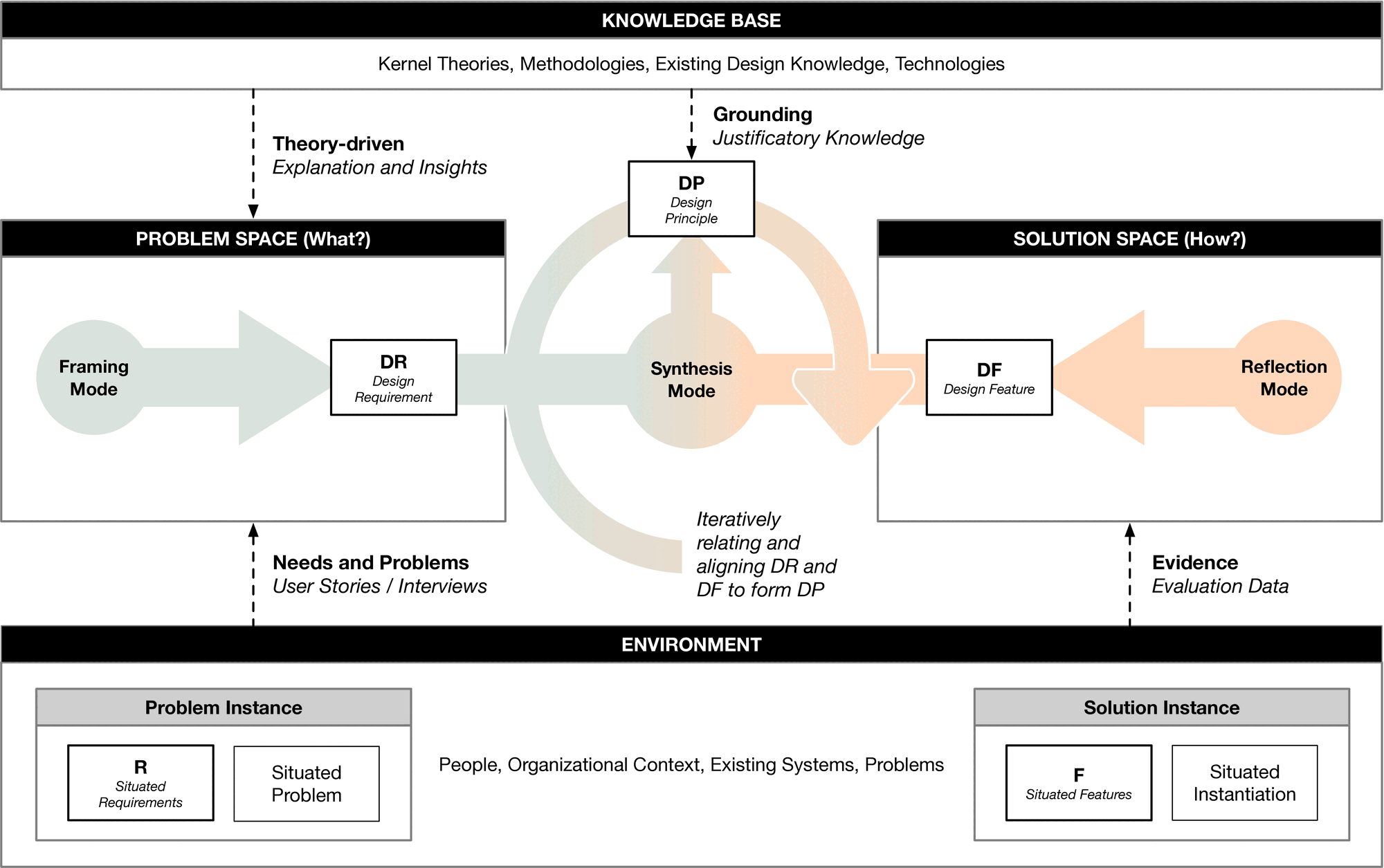
Framing alone yields requirements, not principles. Reflection alone yields features, not principles. Principles emerge in synthesis, when the two sides are matched. This is why projects that stay theory-led produce aspirational principles that are hard to build, and why projects that stay solution-led produce narrow ones. One can read the framework as a specialization of Hevner’s (2007) three-cycle view of design science, applied to principles.
03 / Alignment
The level of a principle is relative.
The second element explains the failure modes. Requirements, principles, and features can each be written more concretely or more abstractly (Strohmann & Khosrawi-Rad, 2025; Wache et al., 2022; Winter & Albani, 2025). There is no correct level for any of them in isolation. What matters is their position relative to each other.
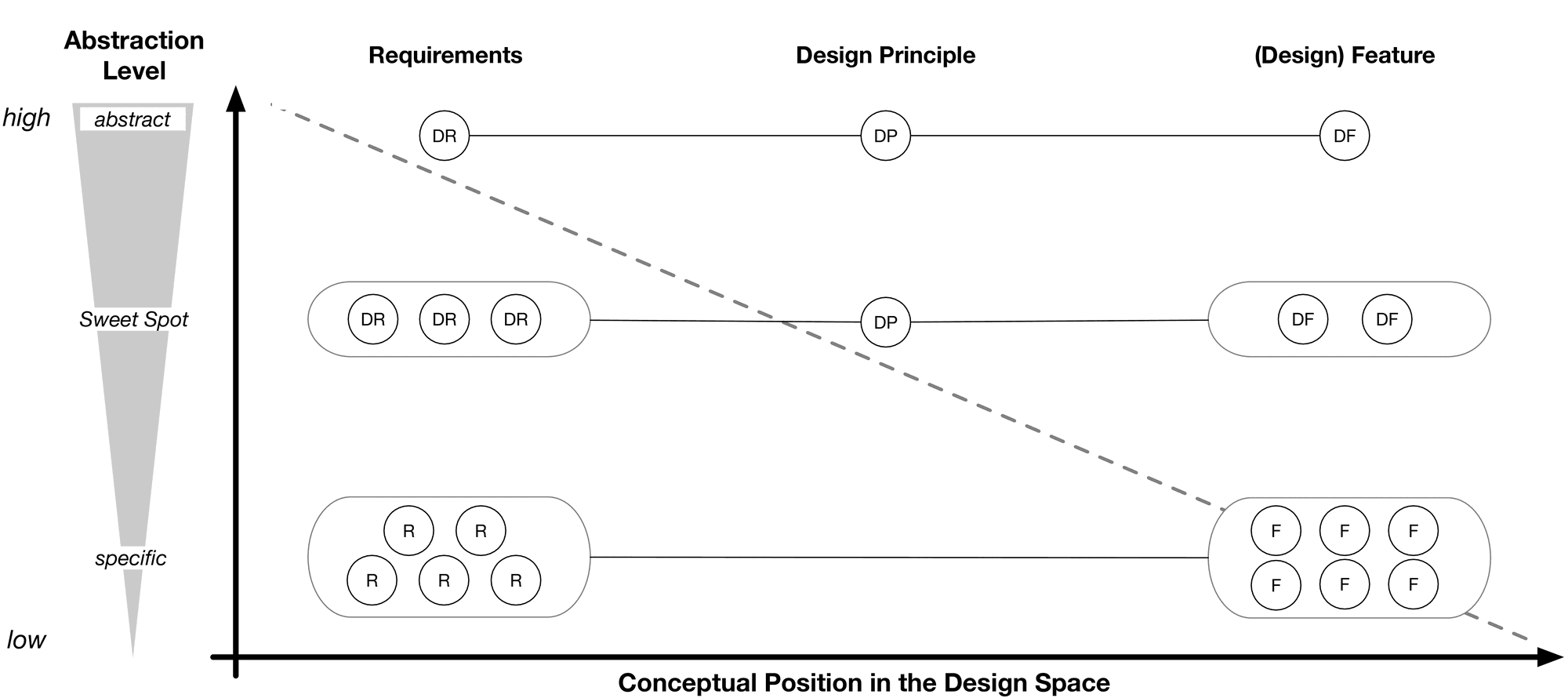
Three misalignments follow. Requirements framed for a broad problem class with features tied to one system produce vague principles, because the gap between them is too wide to reason across. Narrow, situated requirements with highly abstract features collapse into local heuristics. And principles articulated at a level that neither requirements nor features support look theoretically appealing but are grounded in nothing. Naming these patterns turns the model into a diagnostic tool: when a candidate principle will not settle, ask which side is at the wrong level.
04 / Moves
Five ways to move.
The third element is a vocabulary for the recurring actions through which researchers actually navigate the space. They are not steps in a method. They can be combined, repeated, and revisited.
- 1
AbstractionUpward
Generalize from situated needs and features to reusable requirements, design features, and candidate principles.
- 2
SpecializationDownward
Narrow the scope, clarify boundary conditions, and sharpen intent without yet building anything.
- 3
InstantiationDownward, across the boundary
Turn requirements or principles into a concrete artifact that can be built and evaluated.
- 4
AlignmentHorizontal
Match what a solution should achieve with how solutions are realized, at compatible levels of abstraction.
- 5
StabilizationIn place
Strengthen grounding, spell out mechanisms, and improve articulation without changing the level.
05 / Demonstration
One principle, four snapshots.
To show that the scaffold describes something real, we reconstructed the history of a single principle from our earlier project on virtual companionship (Strohmann et al., 2023): the principle of relationship, which addresses the move from transactional assistance to sustained companionship.
It began in framing mode, derived almost entirely from theories of interpersonal relationships and the need to belong. The result was a candidate principle with a strong aspiration and little actionable content. When we tried to build it, it was unclear which system properties would actually deliver a long-term relationship. That forced a shift into reflection mode: we analyzed the companion app Replika and ran a longitudinal study, and abstracted the features that seemed to sustain relationship continuity. Synthesis then matched the two sides, and the principle stabilized into the version that was published.
Establish a warm, positive and long-term relationship in order to ensure constant reuse and thus make and maintain friendship and form interpersonal attachment to satisfy the user’s need for belonging.
Aspirational, but silent on how. Framing without reflection.
To establish a warm, positive, and long-term relationship and thus stimulate and maintain companionship between human and virtual companion, ensure regular re-use and follow the principles of friendship and collaboration, because human beings are fundamentally and pervasively motivated by a need to belong, which results in a strong desire to form and maintain enduring interpersonal attachments.
Mechanisms and grounding appear, once features abstracted from Replika and Sarah were aligned with the requirement.
For users interacting repeatedly with a conversational agent over time, in contexts where interaction extends beyond isolated, transactional tasks, designers should design the companion to actively sustain relationship continuity by enabling regular re-use and implementing relationship-oriented interaction mechanisms that ensure continuity across interactions, proactive relational engagement, reciprocal exchange, and shared conversational or collaborative activities, because humans are fundamentally motivated by a need to belong and, consistent with the CASA paradigm, tend to apply social expectations and relational norms to interactive systems, making such interaction patterns capable of eliciting perceived companionship rather than mere task support.Applying the framework retrospectively adds context, the designer’s role, and a sociotechnical bridge via the CASA paradigm (Nass & Moon, 2000), without changing the intent.
The demonstration is an analytical illustration, not an evaluation of a method. Its point is that the evolution of a principle becomes traceable and discussable once the moves are named.
06 / What it adds
Connective tissue between process and anatomy.
Existing guidance tells researchers which activities to perform (Möller et al., 2020), and what a finished principle should contain (Gregor et al., 2020). This paper supplies what sits between: an account of the reasoning that development must manage, and an explanation of why the quality problems reported in prior work arise when it is not managed (Khosrawi-Rad et al., 2024; Möller et al., 2022). It does not favor theory-led or solution-led strategies. It says that principle quality depends on whether the two sides are expressed at compatible levels.
For practitioners, who tend to use principles as flexible orientation rather than strict instruction (Chandra Kruse et al., 2022), making requirements, principles, and features explicit and aligned turns abstract prescriptions into something discussable without collapsing into implementation detail.
Behind the paper
The idea, and
the path to it.
A paper presents the polished result. This is the part that usually stays unwritten: where the question came from and how the work actually unfolded.
Design principles have accompanied me for years. In Information Systems research they have become a core output construct for design knowledge and for design-theoretical contributions. I have dealt with their construction in many papers, from the design theory for virtual companionship to an analysis of how principles are constructed and formulated across the field, and in mentoring and in my design science research courses, where explaining how researchers build principles taught me a great deal and made me reflect on it.
We had an anatomy for design principles, thanks to Gregor et al. (2020), and various ideas about what the process looks like. It was still incomplete. The conversation with Robert Winter began at the Wirtschaftsinformatik conference in 2025, and it became a long-running discussion about how design principles actually come into being. Robert had a very similar view, and decisive impulses on abstraction levels: his chapter with Antonia Albani on abstraction in design science research, Winter and Albani (2025), was central to the thinking here. A year earlier at DESRIST, Robert had been session chair when I presented the paper on the relevance of design features, and we were already discussing how design features are constructed. This paper is where those conversations arrived.
References
Bichler, M. (2006). Design science in information systems research. Wirtschaftsinformatik, 48(2), 133–135. doi:10.1007/s11576-006-0028-8
Chandra Kruse, L., Purao, S., & Seidel, S. (2022). How designers use design principles: Design behaviors and application modes. Journal of the Association for Information Systems, 23(5), 1235–1270. doi:10.17705/1jais.00759
Gregor, S., Chandra Kruse, L., & Seidel, S. (2020). Research perspectives: The anatomy of a design principle. Journal of the Association for Information Systems, 21(6), 1622–1652. doi:10.17705/1jais.00649
Gregor, S., & Hevner, A. R. (2013). Positioning and presenting design science research for maximum impact. MIS Quarterly, 37(2), 337–355. doi:10.25300/MISQ/2013/37.2.01
Hevner, A. R. (2007). A three cycle view of design science research. Scandinavian Journal of Information Systems, 19(2), Article 4. aisel.aisnet.org
Khosrawi-Rad, B., Grogorick, L., Strohmann, T., & Robra-Bissantz, S. (2024). Toward a method for design science research meta-studies to improve the reusability of design principles. In M. Mandviwalla, M. Söllner, & T. Tuunanen (Eds.), Design science research for a resilient future (pp. 182–196). Springer Nature Switzerland. doi:10.1007/978-3-031-61175-9_13
Möller, F., Guggenberger, T. M., & Otto, B. (2020). Towards a method for design principle development in information systems. In S. Hofmann, O. Müller, & M. Rossi (Eds.), Designing for digital transformation. Co-creating services with citizens and industry (pp. 208–220). Springer International Publishing. doi:10.1007/978-3-030-64823-7_20
Möller, F. O., Hansen, M. R. P., & Schoormann, T. (2022). Synthesizing a solution space for prescriptive design knowledge codification. Scandinavian Journal of Information Systems, 34(2), Article 1. aisel.aisnet.org
Nass, C., & Moon, Y. (2000). Machines and mindlessness: Social responses to computers. Journal of Social Issues, 56(1), 81–103. doi:10.1111/0022-4537.00153
Strohmann, T., & Khosrawi-Rad, B. (2025). The relevance of design features: From abstract knowledge to practical implementation. In S. Chatterjee, J. vom Brocke, & R. Anderson (Eds.), Local solutions for global challenges (pp. 116–134). Springer Nature Switzerland. doi:10.1007/978-3-031-93976-1_8
Strohmann, T., Siemon, D., Khosrawi-Rad, B., & Robra-Bissantz, S. (2023). Toward a design theory for virtual companionship. Human–Computer Interaction, 38(3–4), 194–234. doi:10.1080/07370024.2022.2084620
vom Brocke, J., Winter, R., Hevner, A., & Maedche, A. (2020). Special issue editorial – Accumulation and evolution of design knowledge in design science research: A journey through time and space. Journal of the Association for Information Systems, 21(3), 520–544. doi:10.17705/1jais.00611
Wache, H., Möller, F., Schoormann, T., Strobel, G., & Petrik, D. (2022). Exploring the abstraction levels of design principles: The case of chatbots. In Wirtschaftsinformatik 2022 Proceedings. aisel.aisnet.org
Winter, R., & Albani, A. (2025). Abstraction and abstraction levels in design science research. In R. Winter (Ed.), Designing the information systems artefact: Typology, architecture, abstraction, collaborative evolution and design patterns (pp. 81–100). Springer Nature Switzerland. doi:10.1007/978-3-031-98311-5_3
Sources cited above for the central claims of the paper. The full reference list is in the paper itself.