Behind the paper · Electronic Markets · 2025
Conceptualizing hybrid intelligent service ecosystems
When people and AI co-create value together, the whole service ecosystem changes. This paper gives that change a vocabulary.
“The idea started at the SIG Services workshop at ICIS 2022 in Copenhagen, and the conversation never really stopped.”
Read the story behind the paper
In brief
Two literatures, and neither sees the whole.
Hybrid intelligence research stops at teams. Service research treats AI as a passive tool.
A framework with one new kind of actor.
The human–AI hybrid configures human and artificial agency in every interaction, inside four components that span the micro, meso, and macro levels.
It holds across five very different services.
From semi-autonomous driving to IT support, the concepts describe who acts, what is integrated, and which rules apply.
Five propositions, and a kernel theory.
A research agenda from unequal resource access to hidden hybrids, and a foundation for designing AI agents in service ecosystems.
01 / The gap
Two literatures, neither sees the whole.
Hybrid intelligence research has shown that a person and an AI working together can outperform either alone (Dellermann et al., 2019; Hemmer et al., 2023), and that this works best when the AI has real agency, delegating tasks and shaping the collaboration rather than waiting to be used (Fügener et al., 2022; Gkinko & Elbanna, 2023). But that research stays at the level of individuals and teams (Dellermann et al., 2019). It says little about what happens to the markets, industries, and institutions those teams sit inside.
Service research has the opposite blind spot. Service-dominant logic offers the best available account of how value is co-created across ecosystems of actors bound by shared institutions (Vargo & Lusch, 2004, 2016), and it even allows machines to count as actors (Storbacka et al., 2016). Yet in practice it still files AI under technology: an operand resource, a passive thing that humans apply (Baird & Maruping, 2021; Breidbach & Brodie, 2017; Vargo & Lusch, 2017). Neither literature could explain what the paper calls a hybrid intelligent service ecosystem, a system in which humans and AI configure their agencies together and, in doing so, change the resources and rules of the whole.
02 / The framework
Four components, one new kind of actor.
A HISE is defined as a service ecosystem that leverages human and artificial intelligence to configure human and AI agency as human–AI hybrids. Everything else in the framework follows from that definition. The four components are borrowed from service-dominant logic (Vargo & Lusch, 2011, 2016) and extended so that AI can act, not only be acted upon.
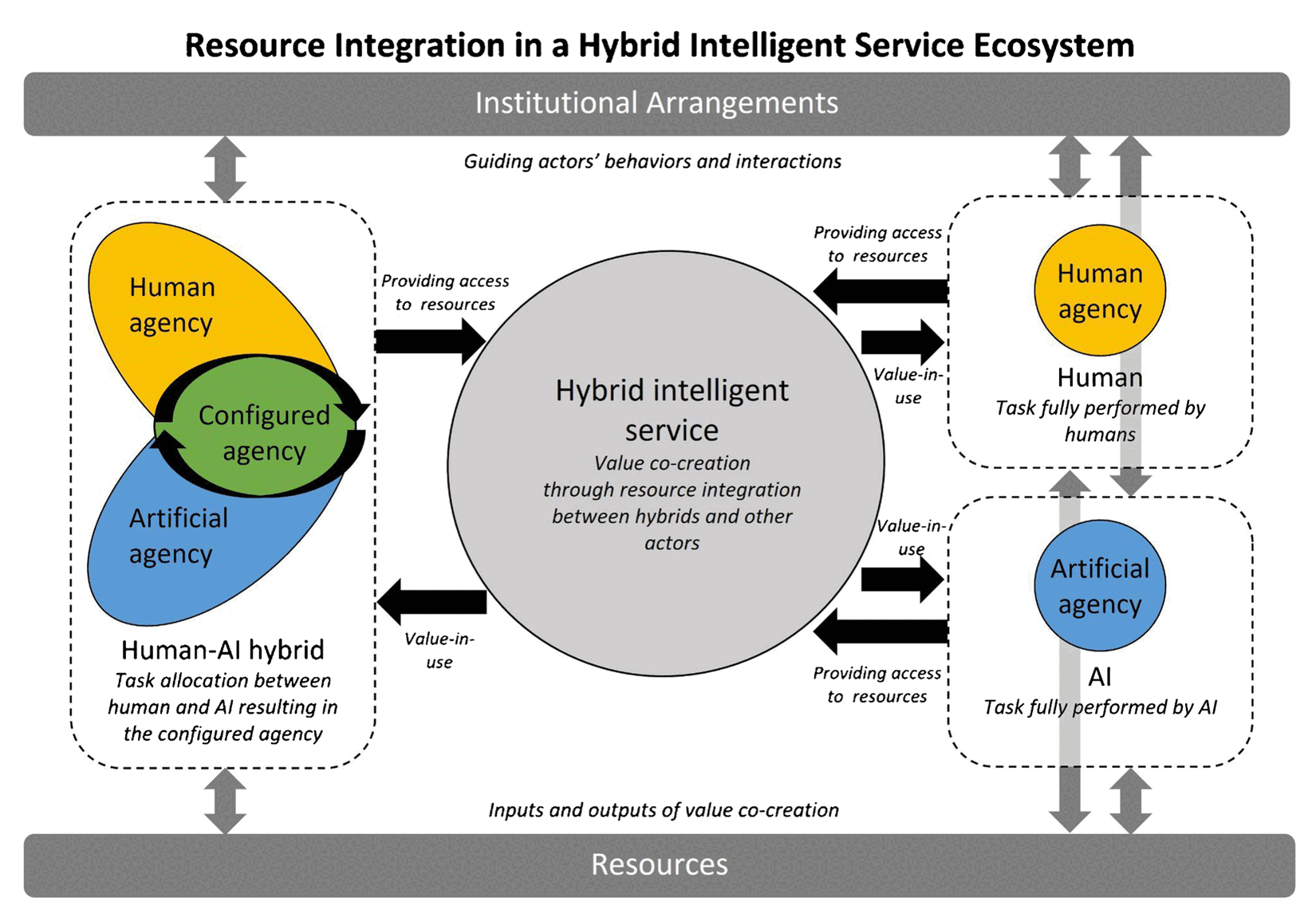
Actors
- Human–AI hybrids, which configure human and artificial agency to perform tasks more effectively
- Human actors, relying on human agency alone
- AI actors, operating on AI agency alone, still rare but anticipated
Hybrid intelligent service
- Value co-creation that involves at least one human–AI hybrid
- Integrates human creativity and context with algorithmic processing and pattern recognition
- Outcomes neither side could reach independently
Resources
- Operant resources that act: skills, knowledge, and advanced AI systems
- Operand resources that are acted upon: infrastructure, devices, data
- Dynamic, and continuously updated by all types of actors
Institutional arrangements
- Formal rules such as data privacy law and the EU AI Act
- Informal norms, cultural expectations, and industry practice
- They enable and constrain how hybrids configure their agency
The hybrid is the interesting part. A radiologist working with an AI that pre-screens images is a hybrid. So is a whole company whose employees work with AI systems, once you zoom out to the organization as the actor. Whether something counts as a hybrid, a human, or an AI depends on the level of aggregation you look at. Within a hybrid, agency is configured situationally: the driver lets the car keep the lane on the motorway and takes over at the ambiguous junction. That configuration is negotiated again in every interaction.
Hybrids can also be hidden. A person may conceal that AI wrote the message, a company may conceal how much of its service is automated. Because the counterpart is not always identifiable, trust and the institutions that govern AI use become central to whether hybrid service exchange works at all.
03 / Five scenarios
From the motorway to the help desk.
To test whether the concepts hold against real-world phenomena, the paper walks five very different service settings through the framework: who the hybrids are, what each side of the agency contributes, which resources are integrated, and which institutions guide it all.
| Scenario | Human agency in the hybrid | Artificial agency in the hybrid |
|---|---|---|
| Semi-autonomous driving | Driver’s situational awareness and edge-case decisions | Lane keeping, adaptive cruise control, collision avoidance |
| Elderly care | Caregiver’s empathy, coordinator’s care management | Personalized care plans, monitoring, early detection |
| Sustainable coding | Engineer’s creativity and problem framing | Carbon-friendly code generation and optimization |
| Precision agriculture | Farmer’s local knowledge, agronomist’s expertise | Irrigation, fertilization, and pest management recommendations |
| IT customer support | Agents validating and refining recommendations | Ticket classification, resolution suggestions, learning from feedback |
The scenarios also show the levels talking to each other. When drivers of semi-autonomous cars were caught sleeping at the wheel, regulators forced manufacturers to add driver monitoring, and the permissible agency configuration inside every hybrid changed. Macro-level institutions reshape micro-level behavior, and micro-level behavior provokes new institutions (Meynhardt et al., 2016; Polese et al., 2021).
04 / Five propositions
What to study next.
- 1
ActorsDynamic configuration
The balance of human and artificial agency in a hybrid is never fixed. It is negotiated in every interaction, depending on task complexity, skills, preferences, and feedback.
- 2
ResourcesUnequal access
Hybrids and AI actors can integrate resources that human-only actors cannot, above all large data. That creates advantages, and potentially power imbalances, inside the ecosystem.
- 3
Information asymmetriesHidden hybrids
Not knowing whether the counterpart is human, AI, or hybrid distorts trust. Transparency builds cooperation; strategic ambiguity can be a competitive move.
- 4
Institutional arrangementsNew governance
Formal and informal institutions have to evolve to handle hybrids and AI actors. The paper even anticipates a shift toward mandatory AI use in some domains.
- 5
Ecosystem evolutionAcceleration
AI’s ability to sense and respond faster speeds up how ecosystems change, which is an opportunity and a systemic risk when human and institutional capacity cannot keep pace.
05 / What it adds
A lens, and a kernel theory.
The paper’s contribution is integrative: it connects hybrid intelligence (Dellermann et al., 2019), service-dominant logic (Vargo & Lusch, 2016), and socio-material agency (Baird & Maruping, 2021; Leonardi, 2011) into one perspective that spans individuals, teams, organizations, and societies. For practitioners it is a way to see AI adoption as a change in the ecosystem rather than a tool purchase, and to look deliberately for new patterns of resource integration, inside the organization and through access to other actors’ AI. At the micro level it helps managers think about which tasks belong to which agency.
For design-oriented research it offers something more specific: a kernel theory. Systems that embed AI agents in service ecosystems, from diagnostic platforms to customer support, can be designed against the framework’s ideas of agency configuration, resource integration, and institutional fit. The paper closes by calling on information systems researchers to develop exactly that prescriptive design knowledge.
That call is being taken up. A forthcoming HICSS study asks how organizations lay the foundations for hybrid intelligent service ecosystems in practice, moving from tooling to teaming, and the cafeteria forecasting project is one concrete instance of a hybrid at work.
Behind the paper
The idea, and
the path to it.
A paper presents the polished result. This is the part that usually stays unwritten: where the question came from and how the work actually unfolded.
The idea started at the workshop of the AIS Special Interest Group on Services at ICIS 2022 in Copenhagen. Eight of us, from Göttingen, Karlsruhe, Nancy, Lappeenranta, St. Gallen, Münster, Bochum, and Munich, kept the conversation going after the workshop, and out of that continuous exchange the conceptualization took shape.
It has not stayed conceptual. We are now carrying the framework into a real-world context in the case of AGRAVIS, in joint design-oriented research on the organizational foundations of hybrid intelligent service ecosystems. The forthcoming HICSS 2027 paper on moving from tooling to teaming extends this work, asking how organizations actually build the foundations the framework describes.
References
Baird, A., & Maruping, L. M. (2021). The next generation of research on IS use: A theoretical framework of delegation to and from agentic IS artifacts. MIS Quarterly, 45(1), 315–341. doi:10.25300/MISQ/2021/15882
Breidbach, C. F., & Brodie, R. J. (2017). Engagement platforms in the sharing economy. Journal of Service Theory and Practice, 27(4), 761–777. doi:10.1108/JSTP-04-2016-0071
Dellermann, D., Ebel, P., Söllner, M., & Leimeister, J. M. (2019). Hybrid intelligence. Business & Information Systems Engineering, 61(5), 637–643. doi:10.1007/s12599-019-00595-2
Fügener, A., Grahl, J., Gupta, A., & Ketter, W. (2022). Cognitive challenges in human–artificial intelligence collaboration: Investigating the path toward productive delegation. Information Systems Research, 33(2), 678–696. doi:10.1287/isre.2021.1079
Gkinko, L., & Elbanna, A. (2023). The appropriation of conversational AI in the workplace: A taxonomy of AI chatbot users. International Journal of Information Management, 69, Article 102568. doi:10.1016/j.ijinfomgt.2022.102568
Hemmer, P., Westphal, M., Schemmer, M., Vetter, S., Vössing, M., & Satzger, G. (2023). Human-AI collaboration: The effect of AI delegation on human task performance and task satisfaction. In Proceedings of the 28th International Conference on Intelligent User Interfaces (pp. 453–463). ACM. doi:10.1145/3581641.3584052
Leonardi, P. M. (2011). When flexible routines meet flexible technologies: Affordance, constraint, and the imbrication of human and material agencies. MIS Quarterly, 35(1), 147–167. doi:10.2307/23043493
Meynhardt, T., Chandler, J. D., & Strathoff, P. (2016). Systemic principles of value co-creation: Synergetics of value and service ecosystems. Journal of Business Research, 69(8), 2981–2989. doi:10.1016/j.jbusres.2016.02.031
Polese, F., Payne, A., Frow, P., Sarno, D., & Nenonen, S. (2021). Emergence and phase transitions in service ecosystems. Journal of Business Research, 127, 25–34. doi:10.1016/j.jbusres.2020.11.067
Storbacka, K., Brodie, R. J., Böhmann, T., Maglio, P. P., & Nenonen, S. (2016). Actor engagement as a microfoundation for value co-creation. Journal of Business Research, 69(8), 3008–3017. doi:10.1016/j.jbusres.2016.02.034
Vargo, S. L., & Lusch, R. F. (2004). Evolving to a new dominant logic for marketing. Journal of Marketing, 68(1), 1–17. doi:10.1509/jmkg.68.1.1.24036
Vargo, S. L., & Lusch, R. F. (2011). It’s all B2B…and beyond: Toward a systems perspective of the market. Industrial Marketing Management, 40(2), 181–187. doi:10.1016/j.indmarman.2010.06.026
Vargo, S. L., & Lusch, R. F. (2016). Institutions and axioms: An extension and update of service-dominant logic. Journal of the Academy of Marketing Science, 44(1), 5–23. doi:10.1007/s11747-015-0456-3
Vargo, S. L., & Lusch, R. F. (2017). Service-dominant logic 2025. International Journal of Research in Marketing, 34(1), 46–67. doi:10.1016/j.ijresmar.2016.11.001
Sources cited above for the central claims of the paper. The full reference list is in the paper itself.