Behind the paper · DESRIST · 2026
Making the implicit explicit: excavating latent design knowledge with AI
Engineering papers are full of design knowledge that is never written down as such. AIDE is a pipeline that digs it out, with people in charge.
“It started at a circular economy workshop in Karlsruhe, where I brought the design science perspective to a room that knew the domain far better than I did.”
Read the story behind the paper
In brief
The knowledge is there, just not written as knowledge.
Engineering and applied computer science papers are full of design insight, reported as performance rather than principles.
AIDE, a human-in-the-loop excavation pipeline.
Three knowledge states, with AI for detection and drafting and humans for scoping, interpretation, and verification.
One validated principle per paper, across 99 papers.
Demonstrated on a corpus about AI for the circular economy, with the extraction prompt refined over five rounds.
Design science as an integrating meta-discipline.
It can harvest what other fields already know implicitly, instead of remaining a self-referential specialty.
01 / The problem
The knowledge is there. It is just not written as knowledge.
A paper that presents a more accurate neural network for sorting waste, or a better sensor arrangement for predicting when a machine will fail, contains design decisions and reasons for them. The authors rarely say why the design works in a way that could transfer elsewhere, because their field rewards performance, not theorizing (Blessing & Chakrabarti, 2009; Bichler, 2006; Gregor & Hevner, 2013). The guidance is hard-coded into parameter choices, architecture diagrams, and trade-off discussions.
Design science research has developed careful structures for stating design knowledge, such as the anatomy of a design principle with its aim, mechanism, and rationale (Gregor et al., 2020). What it lacks is a way to find and assess knowledge that was never stated in those terms. Systematic reviews map topics and summarize findings (Moher et al., 2015; Sim & Mengshoel, 2023). Existing tools that index design knowledge assume it is already labeled (Gau et al., 2023). Methods for reconstructing design rationale from real-world artifacts exist (Maedche et al., 2021; Chandra Kruse et al., 2019), but they are manual and slow.
The research question follows: how can latent design knowledge embedded in diverse, non-DSR publications be systematically excavated to formulate reusable design knowledge?
02 / The framework
Three knowledge states, two roles.
AIDE, short for AI-assisted design knowledge excavation, is framed as an epistemic transformation. The center column of the framework tracks the state of the team’s knowledge. The left column says what the AI agent does to move it forward. The right column says what the human expert does. At no point does the AI theorize on its own.
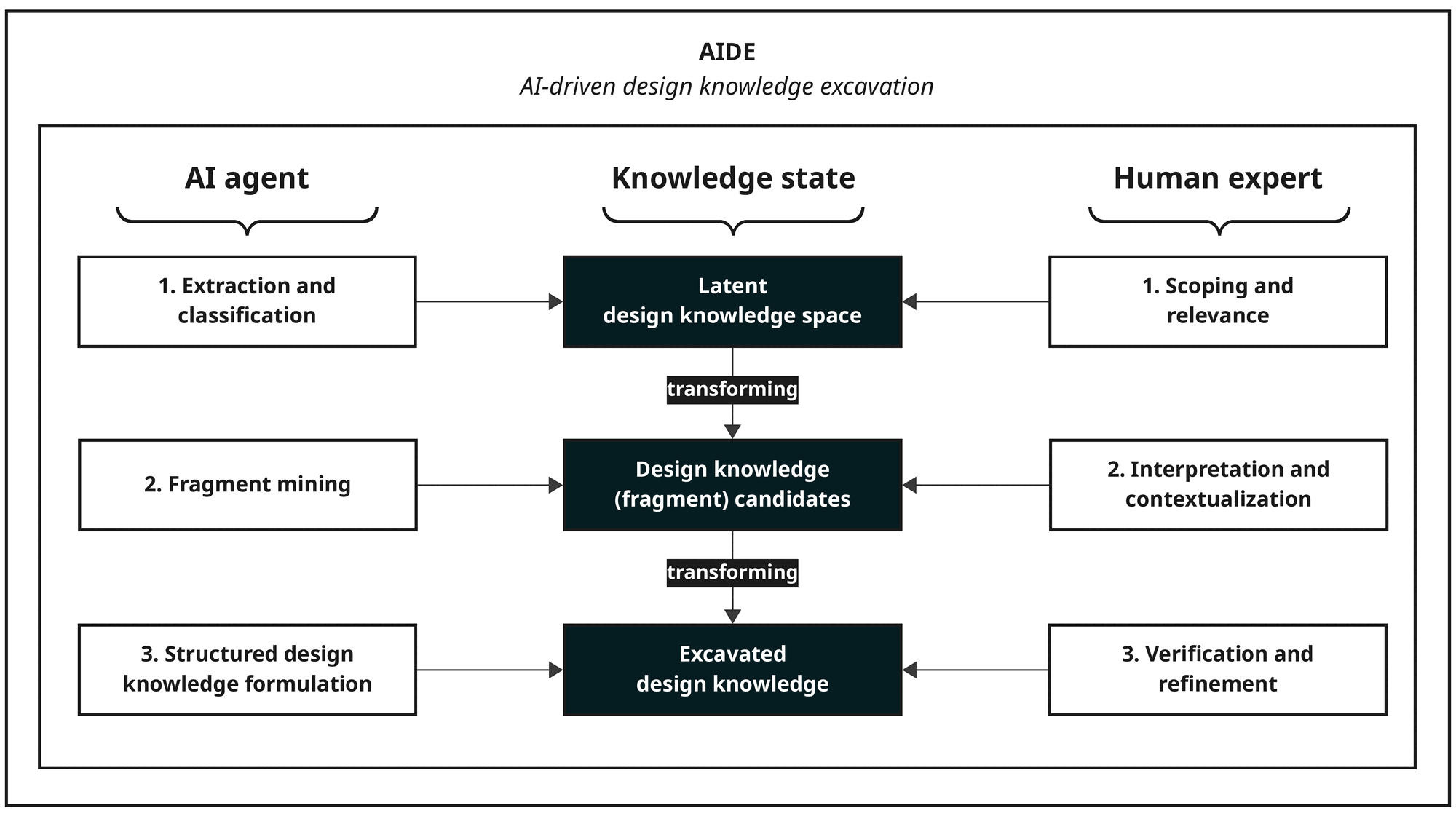
Latent design knowledge space
- AI: extraction and classification of candidate papers
- Human: scoping, inclusion criteria, relevance
- Instantiated as an Airtable repository with curated metadata and annotations
Design knowledge candidates
- AI: fragment mining, surfacing prescriptive statements and their rationale
- Human: interpretation and contextualization, separating guidance from incidental description
- Instantiated as an n8n workflow over the full text
Excavated design knowledge
- AI: drafting a design attribute postulate and a full principle in the standard anatomy
- Human: verification and refinement, checking grounding, abstraction, and hallucination
- Written back to the repository for review
03 / How it was built
Exploring by building.
The project started in January 2025 from a practical bind. An interdisciplinary team on AI for the circular economy had to analyze nearly a hundred engineering and applied computer science papers for their prescriptive insight, and no method said how. Following the principle of exploring by building (Vaishnavi & Kuechler, 2015), the team bootstrapped heuristics and prompts by experimenting directly in ChatGPT and Gemini, comparing what each extracted. A first attempt to build custom software proved too complex, so the pipeline moved to the workflow tool n8n, with the extraction prompt refined over five rounds on a subset of papers.
Each round was checked from two sides. Circular economy experts judged whether the extracted insight was technically correct and faithful to the source. Design science experts judged completeness, level of abstraction, and fit with established knowledge structures. Six researchers with two to ten years of design science experience and two to seven years in the domain formed the team; one joined late specifically to evaluate the method from outside.
The instantiation is deliberately ordinary: Airtable holds the papers and the human annotations, n8n orchestrates the steps, and Gemini Flash 2.5 does the reading. Ninety-nine papers took an hour and a half. The paper is explicit that these tools are illustrative. The logic of human scoping, AI extraction, and reflexive validation transfers to any stack.
04 / Demonstration
From a waste-management paper to a design principle.
The corpus came from a PRISMA-guided search (Moher et al., 2015) across Scopus, Web of Science, IEEE Xplore, and the AIS library: 1,116 records, screened to 218 for full-text assessment, and finally 99 papers that reported an implemented artifact, linked AI to a circular economy strategy, and carried enough design signal to reconstruct intent. The papers cover predictive maintenance, automated sorting and disassembly, and optimization for resource-efficient design.
The worked example is a study on AI in municipal waste management (Lanzalonga et al., 2025). Its prescriptive intent is implicit: users should be recognized, sensors should measure what they throw away, and incentives should reward good behavior. AIDE surfaced those fragments and formalized them into a design attribute postulate (Chatterjee et al., 2024) and a full design principle (Gregor et al., 2020).
A study of how AI can improve decision-making for circular economy practices in the utility sector, describing digital user IDs, bin sensors, and AI-based prediction of fill levels, without stating any of it as design knowledge.
User recognition via digital IDs. Sensors measuring the volume of waste added to bins. AI systems predicting bin refilling and verifying disposal consistency. Economic incentives as the lever for a proactive user role.
Principle of AI-driven incentivized waste management for circular economy: implement a point-based compensatory tariff system that identifies users, measures their sorted waste with embedded sensors, predicts fill levels to optimize collection routes, and rewards users for quality and quantity, because economic incentives and transparent feedback on individual actions modify behavior toward desired outcomes.Condensed from Table 1 in the paper, which also names implementers, users, context, and empirical evidence.
05 / What it adds
Design science as an integrating meta-discipline.
Three implications follow. First, grounding a design project is no longer only about choosing the right theory or collecting your own data (Goldkuhl, 2004; Iivari, 2015; Schoormann et al., 2022). It can mean actively reconstructing prescriptive intent from the long tail of artifact-oriented research in other fields. Second, responding to calls for carefully managed human–AI ensembles in design research (Schoormann et al., 2025), the paper makes the human–AI division of labor concrete: AI for detection, reconstruction, and schema-conformant drafting at scale; humans for interpretation, abstraction decisions, and validation. Third, literature work shifts from search and synthesis toward excavation and structuring as a core research activity.
The limits are stated plainly. Poorly documented studies offer little to excavate. Language models have context windows, cost, and stability constraints. The demonstration is a proof of concept at the level of single papers; consolidating principles across papers, preserving boundary conditions, and handling competing prescriptions are the next problems, along with comparing the pipeline against manual extraction.
Behind the paper
The idea, and
the path to it.
A paper presents the polished result. This is the part that usually stays unwritten: where the question came from and how the work actually unfolded.
This started at a workshop on the circular economy at the Karlsruhe Institute of Technology, where I met domain experts from Information Systems who work on AI in the circular economy. My own contribution was methodological: I brought the design science and design knowledge perspective to a group that knew the domain far better than I did. In the discussion it became clear that the use of AI in the circular economy is badly under-examined in Information Systems research, and that we could contribute something.
An author team formed, design science experts and, above all, circular economy domain experts from the IS field, and we proceeded by exploring by building: we extracted exactly that design knowledge from the literature. That produced the ECIS paper on the AI-enabled circular economy. This paper is the methodological contribution alongside it: a reflection on what we actually did, and on how the latent design knowledge was excavated.
References
Bichler, M. (2006). Design science in information systems research. Wirtschaftsinformatik, 48(2), 133–135. doi:10.1007/s11576-006-0028-8
Blessing, L. T. M., & Chakrabarti, A. (2009). DRM, a design research methodology. Springer. doi:10.1007/978-1-84882-587-1
Chandra Kruse, L., Seidel, S., & vom Brocke, J. (2019). Design archaeology: Generating design knowledge from real-world artifact design. In B. Tulu, S. Djamasbi, & G. Leroy (Eds.), Extending the boundaries of design science theory and practice (pp. 32–45). Springer. doi:10.1007/978-3-030-19504-5_3
Chatterjee, S., Bhattacherjee, A., & Gilb, T. (2024). A typology of knowledge creation in design science research projects. In M. Mandviwalla, M. Söllner, & T. Tuunanen (Eds.), Design science research for a resilient future (pp. 141–154). Springer. doi:10.1007/978-3-031-61175-9_10
Gau, M., Maedche, A., & vom Brocke, J. (2023). Accessing the design science knowledge base: A search engine for the accumulation of knowledge across decentrally organized publications. In A. Gerber & R. Baskerville (Eds.), Design science research for a new society: Society 5.0 (pp. 266–278). Springer. doi:10.1007/978-3-031-32808-4_17
Goldkuhl, G. (2004). Design theories in information systems: A need for multi-grounding. Journal of Information Technology Theory and Application, 6(2), Article 7. aisel.aisnet.org
Gregor, S., Chandra Kruse, L., & Seidel, S. (2020). Research perspectives: The anatomy of a design principle. Journal of the Association for Information Systems, 21(6), 1622–1652. doi:10.17705/1jais.00649
Gregor, S., & Hevner, A. R. (2013). Positioning and presenting design science research for maximum impact. MIS Quarterly, 37(2), 337–355. doi:10.25300/MISQ/2013/37.2.01
Iivari, J. (2015). Distinguishing and contrasting two strategies for design science research. European Journal of Information Systems, 24(1), 107–115. doi:10.1057/ejis.2013.35
Lanzalonga, F., Marseglia, R., Irace, A., & Biancone, P. P. (2025). The application of artificial intelligence in waste management: Understanding the potential of data-driven approaches for the circular economy paradigm. Management Decision, 63(10), 3281–3299. doi:10.1108/MD-10-2023-1733
Maedche, A., Gregor, S., & Parsons, J. (2021). Mapping design contributions in information systems research: The design research activity framework. Communications of the Association for Information Systems, 49, 355–378. doi:10.17705/1CAIS.04914
Moher, D., Shamseer, L., Clarke, M., Ghersi, D., Liberati, A., Petticrew, M., Shekelle, P., Stewart, L. A., & PRISMA-P Group. (2015). Preferred reporting items for systematic review and meta-analysis protocols (PRISMA-P) 2015 statement. Systematic Reviews, 4, Article 1. doi:10.1186/2046-4053-4-1
Schoormann, T., Gupta, S., Möller, F., & Chandra Kruse, L. (2025). With great power comes great responsibility: Responsible management of artificial intelligence in supporting design research activities. Proceedings of the 58th Hawaii International Conference on System Sciences (HICSS-58). doi:10.24251/HICSS.2025.649
Schoormann, T., Möller, F., & Chandra Kruse, L. (2022). Uncovering strategies of design principle development [Research-in-progress paper]. 17th International Conference on Design Science Research in Information Systems and Technology (DESRIST 2022), St. Petersburg, FL, United States. usf.edu
Sim, J., & Mengshoel, A. M. (2023). Metasynthesis: Issues of empirical and theoretical context. Quality & Quantity, 57(4), 3339–3361. doi:10.1007/s11135-022-01502-w
Sources cited above for the central claims of the paper. The full reference list is in the paper itself.