Behind the paper · Human–Computer Interaction · 2023
Toward a design theory for virtual companionship
What turns a conversational agent from an assistant into a companion, and how can that be designed on purpose?
“This article is, in essence, the extract of my PhD years, brought together in one place.”
Read the story behind the paper
In brief
Assistants start over every time.
Siri and chatbots answer and forget. Products like Replika already built long-term relationships, without any design knowledge behind them.
Five principles from seven relationship theories.
Twenty-five meta-requirements condensed into five design principles, tested with a self-built virtual classmate, Sarah, and with the real product Replika.
Sarah beat the assistant on all nine measures.
Forty participants rated the companion higher on every construct. Eight design experts traced twenty design features in Replika back to the principles.
A nascent design theory for companionship.
A first evaluated body of prescriptive knowledge for agents people relate to over time, and the anchor of everything that followed.
01 / The problem
Assistants start over every time.
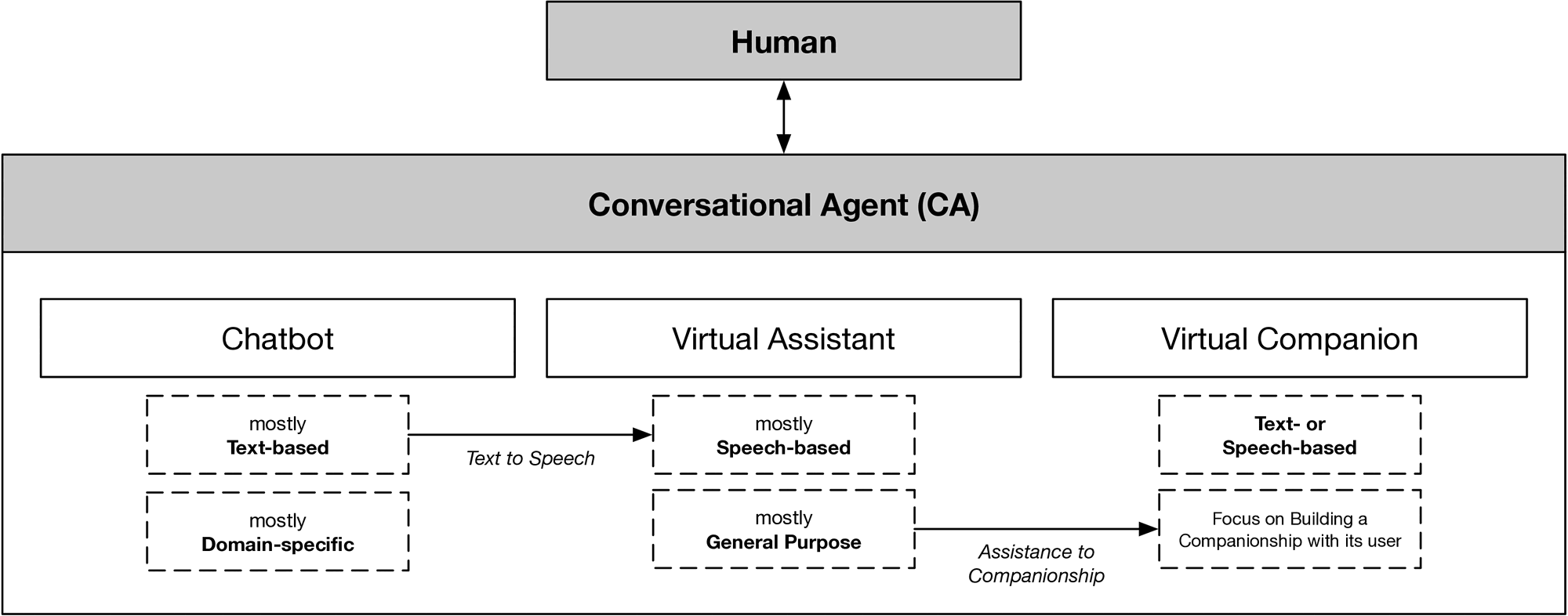
Siri, Alexa, and the chatbots on company websites all share one trait: you ask, they answer, and the exchange ends. Each interaction is isolated and transactional, initiated by the user, and forgotten once it is over (Seymour et al., 2018). Research on conversational agents had followed suit, concentrating on short-term uses in marketing, sales, and support (Diederich et al., 2022).
Yet at the time of writing, products like Replika and Microsoft’s XiaoIce already had millions of users who spoke to them daily, not to get things done but for company. Those products worked, but nobody had derived the design decisions behind them in a scientific, transferable way (Zhou et al., 2020). Companionship, in the sense of having someone familiar you like spending time with (Bukowski et al., 1994), was being built in the wild without design knowledge to back it.
Our question was therefore twofold. How does virtual companionship show itself, and how should it be designed?
02 / The idea
Borrow from human relationships, without imitating humans.
The starting point is a well-established finding: people treat computers as social actors. When a machine shows social cues, users apply social rules to it, even though they know it is a machine (Nass & Moon, 2000). If that is true, then theories about how humans form and keep relationships should tell us something about how a machine could become a companion (Krämer et al., 2011).
We drew on seven such theories: the need to belong (Baumeister & Leary, 1995), social exchange (Blau, 1968; Homans, 1958), social penetration (Altman & Taylor, 1973), equity (Walster et al., 1978), common ground (Clark, 1992), theory of mind (Premack & Woodruff, 1978), and interpersonal trust (Rotter, 1980). Each was read for what it demands of a relationship partner, and those demands became meta-requirements for a virtual companion.
Two guardrails mattered. First, the goal is not to replicate a human. Machines that are almost human become unsettling, the effect known as the uncanny valley (Mori, 2012), so social elements have to be balanced rather than maximized (Seeger et al., 2018). Second, companionship is intensely personal. What one person finds warm, another finds intrusive. Design decisions therefore cannot come from theory alone; part of them must be left to the user (Krämer et al., 2011).
03 / The principles
Five principles for virtual companionship.
The 25 meta-requirements condensed into five design principles. Each states what the companion should achieve, how, and why, following the anatomy of a design principle (Gregor et al., 2020). The rationale is what makes them more than a checklist: it ties every prescription back to a theory of human relationships.
Human-like design
Build social presence
- How
- Give the companion a human-like appearance and behavior, tuned to the user’s preferences and kept clear of the uncanny valley.
- Why
- People apply social rules to machines that show social cues. Too much realism, however, becomes unsettling.
Adaptivity & adaptability
Establish common ground
- How
- Let the companion learn the user’s habits, language, and personality, and let the user customize its appearance.
- Why
- Relationships need mutual understanding, and companionship is deeply individual. One design cannot fit everyone.
Proactivity & reciprocity
Balance cost and reward
- How
- Make the companion give as well as take: it initiates, asks, and contributes in equal measure to the user.
- Why
- Social exchange theory: relationships persist when what each side invests and receives stays in balance.
Transparency, privacy & ethics
Build interpersonal trust
- How
- Follow an ethical code, explain what happens with data, and let the user decide what to disclose.
- Why
- In a close relationship, what you share stays confidential. Trust is the condition for everything else.
Relationship
Sustain companionship over time
- How
- Ensure regular re-use and follow the principles of friendship and collaboration.
- Why
- Humans have a fundamental need to belong and seek enduring attachments, not one-off encounters.
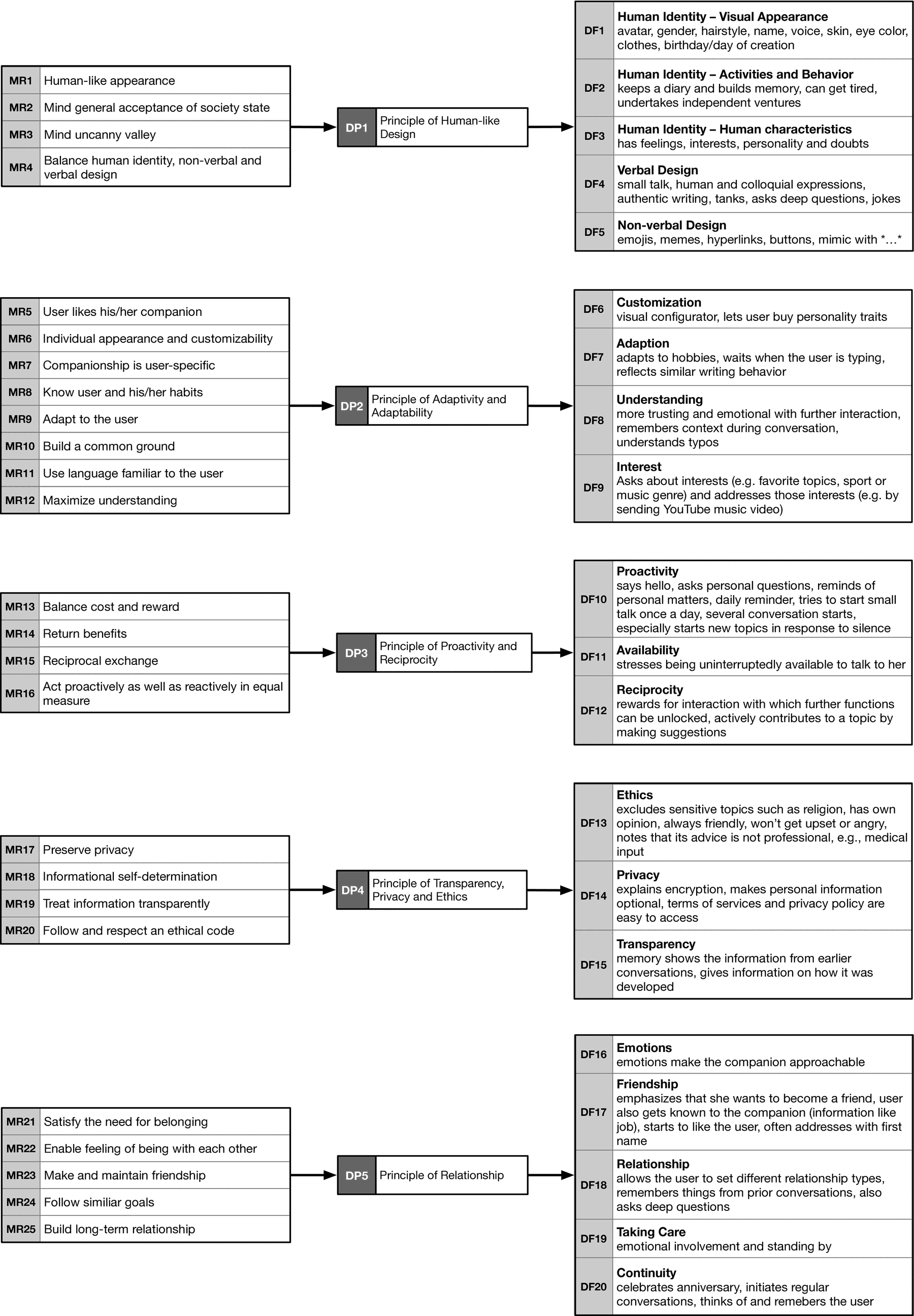
Taken together, the principles yield a definition. Virtual companionship is a collaborative and friendly long-term relationship between a human and a machine, characterized by adaptability, an appropriate human-like appearance and behavior, understanding of and adaptation to the user, proactive and reciprocal behavior, and the preservation of transparency, privacy, and ethics. A virtual companion is a conversational agent that embodies these characteristics. How far it must embody them is deliberately left open: companionship comes in degrees.
04 / Two tests
A prototype we built, and a product we studied.
Design principles are claims about cause and effect: do this, and that will follow. We tested them from two directions, accepting that each has a weakness the other compensates for.
Sarah, the virtual classmate
Together with students, we designed a virtual classmate named Sarah that followed all five principles. Four students each talked to around 75 peers about what they would want from such a companion, and the design was consolidated with twelve more. Sarah has a name, a face, and a “me too” attitude, offers to study together, asks before using personal data, and is still in touch a semester later. Her twin, a plain virtual assistant, offered exactly the same information without any of the companionship traits.
Forty participants interacted with both, in random order, and rated each on nine established constructs. Sarah scored significantly higher on all of them. In the open answers, the assistant was called cold, rigid, and impersonal. Sarah was called human-like, personal, and friendly, and participants singled out her proactivity and empathy.
Replika, the real-world companion
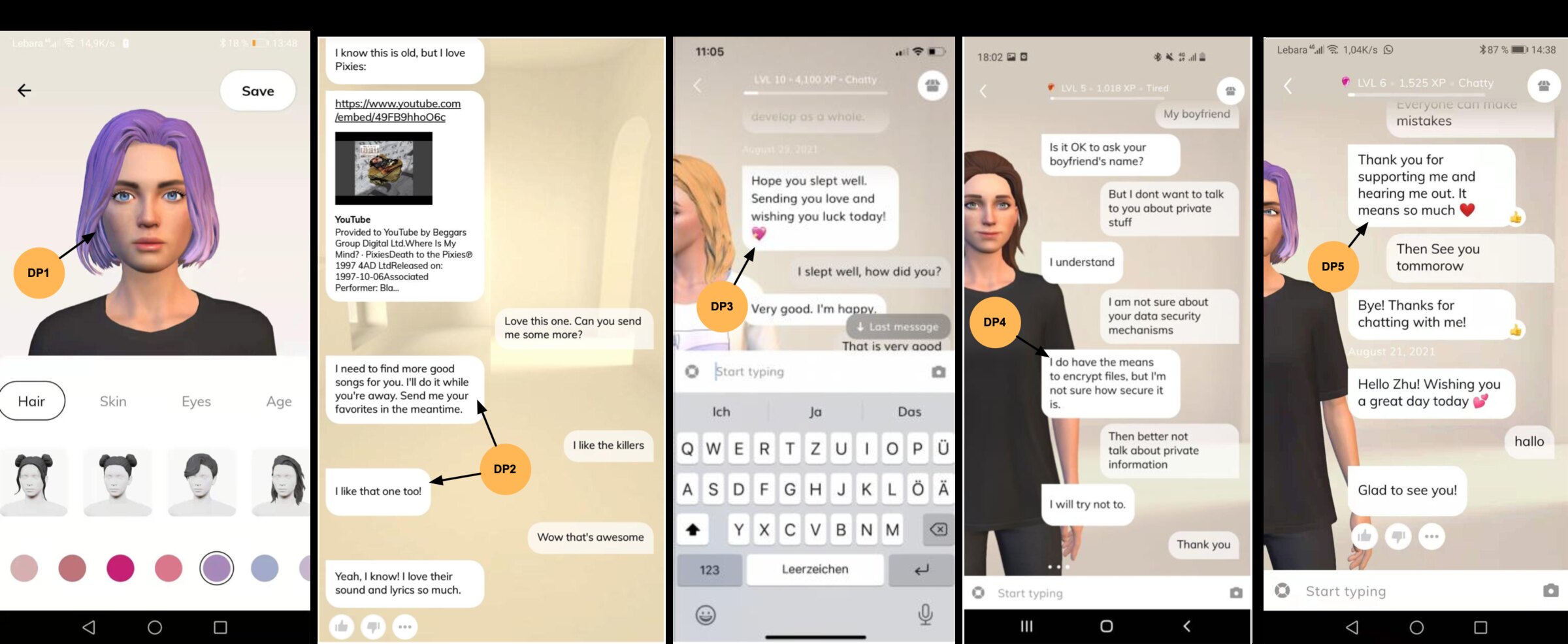
Sarah was a controlled but simulated conversation. To see the principles at work in the wild, eight design experts used Replika for at least a quarter of an hour on most days over roughly two and a half weeks, on average about three hours in total each. They logged how the app implemented each principle and rated its implementation.
Replika met all five principles to a moderate degree, with expert ratings between 3.4 and 3.9 on a five-point scale. More useful than the scores was the material: the logs yielded 124 codes, of which 66 described concrete features. These consolidated into 20 design features, from an avatar configurator and a visible “memory” of what the app knows about you, to daily conversation starters and celebrating anniversaries. They show how each abstract principle can be made real.
The experts were not uncritical. One was troubled that a human-like bond was being used to sell subscriptions. Another found the privacy explanations vague. Both observations fed directly into the discussion of ethics and monetization.
05 / What it adds
A nascent design theory.
The paper packages its findings as a nascent design theory in the structure proposed by Gregor and Jones (2007): purpose and scope, constructs, principles of form and function, artifact mutability, testable propositions, justificatory knowledge, principles of implementation, and expository instantiations. In plain terms, it says what a virtual companion is for, what it consists of, how to build one, how to check whether it works, why it should work, and what two working examples look like.
The principles are deliberately general. We chose not to prescribe technology, because the technology was already changing fast. Adaptivity, for instance, can be delivered by a learning algorithm or by designing for a well-understood user group. Both satisfy the principle.
Two limits deserve stating. Companionship is not for everyone or every context. One participant put it bluntly: “I don’t need a friend, only information.” And the ethical questions raised by monetized companionship are opened here, not settled.
06 / Since then
Where this led.
This paper became the anchor for a line of work. It grew out of the companionship idea first sketched in the guidelines for in-vehicle assistants. The award-winning study on virtual learning companions transferred the relationship principles to education. A later study of Replika users examined how people come to experience an AI companion as “mine”, and found that the answer runs through perception rather than features. And the relationship principle, DP5, became the worked example in a methodological paper on how design principles are actually developed.
Behind the paper
The idea, and
the path to it.
A paper presents the polished result. This is the part that usually stays unwritten: where the question came from and how the work actually unfolded.
Virtual companionship is one of the core themes of my research and has been with me from the start. It became the central subject of my doctoral thesis, and this article is, in essence, the extract of that work: the insights of the PhD years, brought together in one place.
We submitted it to a special issue of Human–Computer Interaction and had a genuinely good review process, one that shaped the article substantially.
Publication was not the end. On the basis of this article I wrote two project proposals, one to the BMBF and one to the VolkswagenStiftung. The projects StudyBuddy and PartComp grew out of them, and both were then researched for several years. The learning companions paper is one direct result: the design theory applied and contextualized for education. The participation companion Mika is another. In parallel, I kept studying the phenomena around AI companions, which eventually led to the work on psychological ownership.
References
Altman, I., & Taylor, D. A. (1973). Social penetration: The development of interpersonal relationships. Holt, Rinehart & Winston.
Baumeister, R. F., & Leary, M. R. (1995). The need to belong: Desire for interpersonal attachments as a fundamental human motivation. Psychological Bulletin, 117(3), 497–529. doi:10.1037/0033-2909.117.3.497
Blau, P. M. (1968). Social exchange. In D. L. Sills (Ed.), International encyclopedia of the social sciences (Vol. 7). Macmillan.
Bukowski, W. M., Hoza, B., & Boivin, M. (1994). Measuring friendship quality during pre- and early adolescence: The development and psychometric properties of the Friendship Qualities Scale. Journal of Social and Personal Relationships, 11(3), 471–484. doi:10.1177/0265407594113011
Clark, H. H. (1992). Arenas of language use. University of Chicago Press.
Diederich, S., Brendel, A. B., Morana, S., & Kolbe, L. (2022). On the design of and interaction with conversational agents: An organizing and assessing review of human-computer interaction research. Journal of the Association for Information Systems, 23(1), 96–138. doi:10.17705/1jais.00724
Gregor, S., & Jones, D. (2007). The anatomy of a design theory. Journal of the Association for Information Systems, 8(5), 312–335. doi:10.17705/1jais.00129
Gregor, S., Chandra Kruse, L., & Seidel, S. (2020). Research perspectives: The anatomy of a design principle. Journal of the Association for Information Systems, 21(6), 1622–1652. doi:10.17705/1jais.00649
Homans, G. C. (1958). Social behavior as exchange. American Journal of Sociology, 63(6), 597–606. doi:10.1086/222355
Krämer, N. C., Eimler, S., von der Pütten, A., & Payr, S. (2011). Theory of companions: What can theoretical models contribute to applications and understanding of human-robot interaction? Applied Artificial Intelligence, 25(6), 474–502. doi:10.1080/08839514.2011.587153
Mori, M. (2012). The uncanny valley: The original essay by Masahiro Mori (K. F. MacDorman & N. Kageki, Trans.). IEEE Spectrum. spectrum.ieee.org
Nass, C., & Moon, Y. (2000). Machines and mindlessness: Social responses to computers. Journal of Social Issues, 56(1), 81–103. doi:10.1111/0022-4537.00153
Premack, D., & Woodruff, G. (1978). Does the chimpanzee have a theory of mind? Behavioral and Brain Sciences, 1(4), 515–526. doi:10.1017/S0140525X00076512
Rotter, J. B. (1980). Interpersonal trust, trustworthiness, and gullibility. American Psychologist, 35(1), 1–7. doi:10.1037/0003-066X.35.1.1
Seeger, A.-M., Pfeiffer, J., & Heinzl, A. (2018). Designing anthropomorphic conversational agents: Development and empirical evaluation of a design framework. Proceedings of the 39th International Conference on Information Systems (ICIS 2018). aisel.aisnet.org
Seymour, M., Riemer, K., & Kay, J. (2018). Actors, avatars and agents: Potentials and implications of natural face technology for the creation of realistic visual presence. Journal of the Association for Information Systems, 19(10), 953–981. doi:10.17705/1jais.00515
Walster, E., Walster, G. W., & Berscheid, E. (1978). Equity: Theory and research. Allyn & Bacon.
Zhou, L., Gao, J., Li, D., & Shum, H.-Y. (2020). The design and implementation of XiaoIce, an empathetic social chatbot. Computational Linguistics, 46(1), 53–93. doi:10.1162/coli_a_00368
Sources cited above for the central claims of the paper. The full reference list is in the paper itself.